
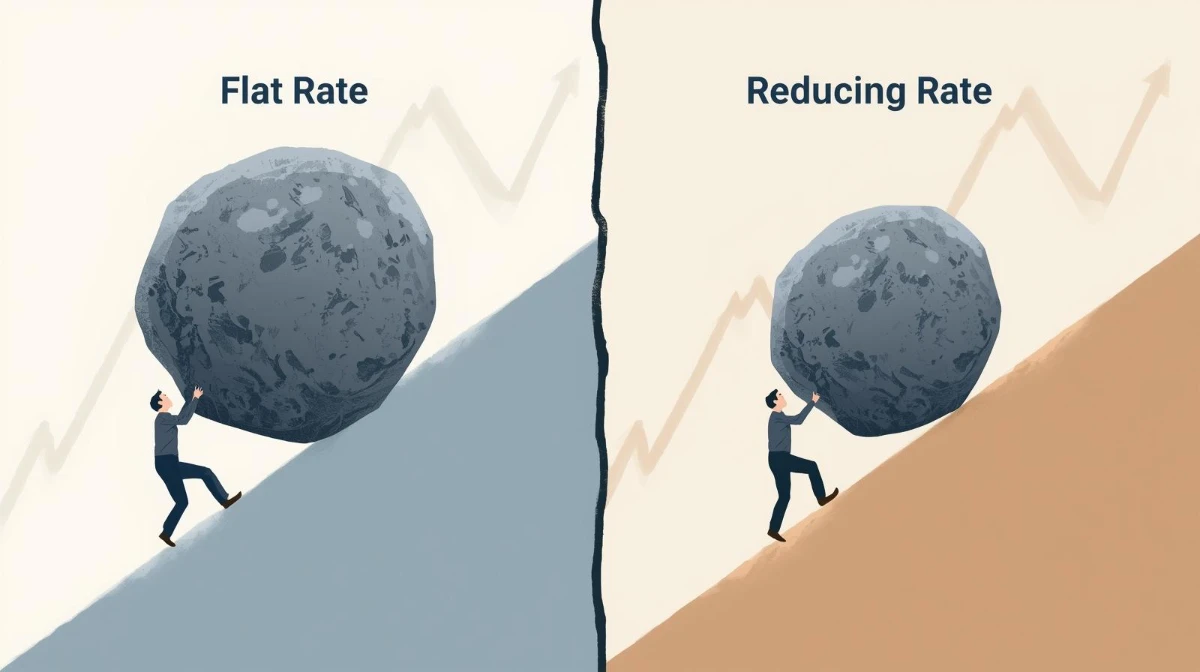
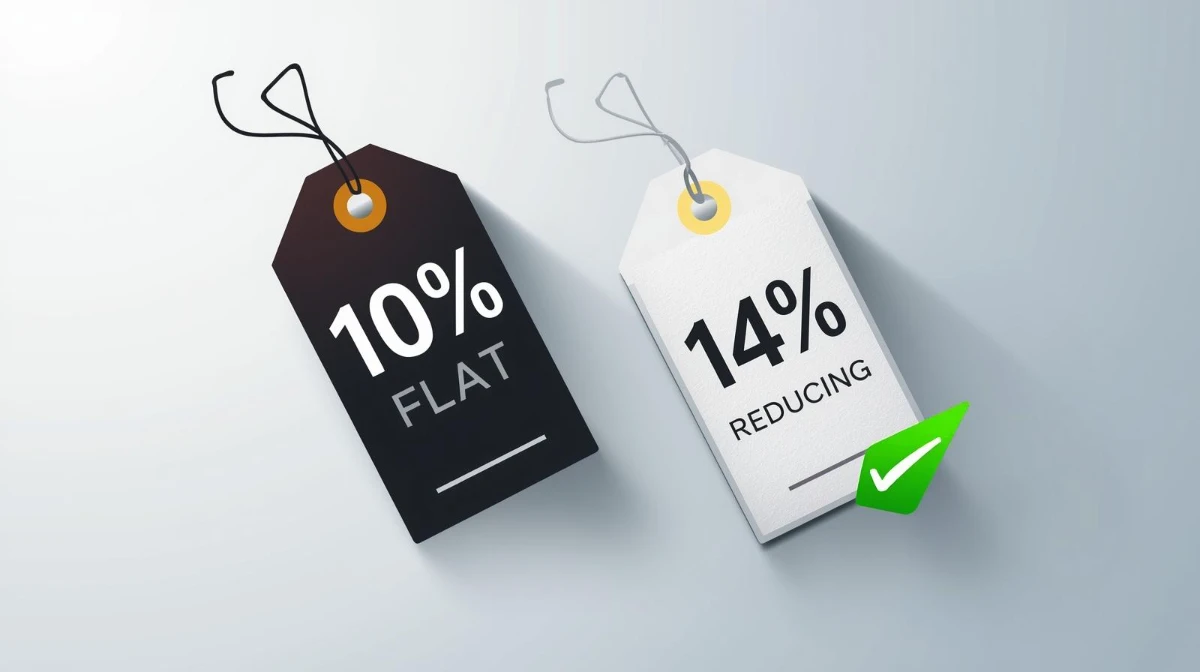
Imagine this: You walk into a dealership or get a call from a loan agent. They offer you a personal loan at a 10% interest rate. You think, “Wow, that’s cheap! My bank is asking for 14%.” You sign the papers immediately, thinking you scored a deal.
Congratulations, you just lost money.
Here is the dirty little secret lenders don’t tell you: A 10% Flat Rate is actually equivalent to roughly 18-19% Reducing Balance Rate.
Many borrowers focus only on the number (10 vs 14) without asking the most critical question: “How is the interest calculated?” This single misunderstanding causes millions of people to pay nearly double the interest they should.
In this guide, we are going to strip away the banking math and show you exactly how the “Flat Rate” trap works, why you should always demand a “Reducing Balance” rate, and how to convert one to the other before you sign the dotted line.
I. The “Flat Rate” Method (The Trap)
This method is mostly used by car dealerships, consumer durable finance (buying a fridge/TV), and some NBFCs.
How It Works
In a Flat Rate scheme, the interest is calculated on the entire principal amount for the entire duration of the loan. It does not matter that you are paying back money every month; the interest calculation assumes you still owe the full amount until the very last day.
- Example:
- Loan Amount: ₹1,00,000
- Rate: 10% Flat
- Tenure: 3 Years
- Interest Calculation: ₹1,00,000 x 10% = ₹10,000 per year.
- Total Interest for 3 Years: ₹30,000.
It sounds simple, right? But it’s unfair because you are paying interest on money you have already repaid.
II. The “Reducing Balance” Method (The Honest Way)
This is the standard method used by major banks for home loans and reputable personal loans.
How It Works
In a Reducing Balance (or Diminishing) method, the interest is calculated only on the outstanding loan balance at the end of each month. As you pay your EMI, your principal decreases, and therefore, your interest payment decreases every single month.
- Example:
- Loan Amount: ₹1,00,000
- Rate: 10% Reducing
- Tenure: 3 Years
- Total Interest for 3 Years: Approx. ₹16,160.
The Shocking Truth:
- Flat Rate Interest Paid: ₹30,000
- Reducing Rate Interest Paid: ₹16,160
At the exact same “10%” rate, the Flat method costs you nearly double the interest.
III. The Comparison Table: See the Real Cost
Let’s look at the numbers side-by-side so you never get fooled again.
| Feature | Flat Interest Rate | Reducing Balance Rate |
| Calculation Base | Calculated on the Full Principal every time. | Calculated only on the Remaining Balance. |
| Effective Cost | Expensive. (A 10% Flat rate ≈ 18% Reducing). | Cheaper. (You pay strictly for what you owe). |
| Who Uses It? | Car dealers, NBFCs, Buy-Now-Pay-Later schemes. | Major Banks, Housing Finance Companies. |
| Transparency | Low. Often used to hide high costs. | High. It reflects the true cost of borrowing. |
IV. Action Plan: How to Spot and Avoid the Trap
Now that you know the difference, here is how to protect yourself during your next loan negotiation.
1. Ask the “Golden Question”
Never just ask, “What is the interest rate?” Always ask: “Is this a Flat rate or a Reducing Balance rate?” If the agent hesitates or tries to confuse you, assume it’s Flat.
2. Use the “Multiply by 1.8” Rule of Thumb
If you want to compare a Flat Rate offer with a Reducing Rate offer quickly in your head, use this trick:
- Flat Rate x 1.8 ≈ True Reducing Rate
- Example: If an agent offers 10% Flat, think: 10×1.8=18%.
- Now compare: Is 18% (the true cost of the agent’s offer) better than the 14% Reducing rate your bank offered? No. The bank wins.
3. Negotiate for Reducing
If a lender quotes a Flat rate, ask them to convert it to a Reducing Balance scheme. If they refuse, calculate the real cost using an online “Flat vs Reducing Calculator” and see if it’s actually worth it. Often, walking away is the best option.
Conclusion: Don’t Pay for What You Don’t Owe
The Flat Interest Rate is a relic of deceptive marketing. It exists solely to make expensive loans look cheap. Remember, fair lending means you should only pay interest on the money you are currently using, not the money you borrowed three years ago. By insisting on a Reducing Balance Rate, you ensure that your hard-earned EMI payments are actually knocking down your debt, not just lining the lender’s pockets.
READ MORE – The “No-Spend Month” Challenge: How to Reset Your Financial Habits and Save Fast
❓ Frequently Asked Questions (FAQ)
Q1. Can I convert my existing Flat Rate loan to a Reducing Rate loan?
A. Usually, no. Once you sign the loan agreement, the terms are locked. However, you can opt for a Balance Transfer. This means taking a new loan from a different bank (at a Reducing Rate) to pay off the old expensive Flat Rate loan. This saves money if the new rate is significantly lower.
Q2. Are “0% Interest” EMI schemes actually Flat Rate loans?
A. Often, yes. “No Cost EMI” schemes typically involve a processing fee or a hidden interest cost built into the product price. While they mathematically look like 0%, if you miss a payment, the penalties are calculated on the principal, similar to a Flat Rate structure. Always read the fine print.
Q3. Is the EMI amount constant in the Reducing Balance method?
A. Yes! This confuses people. In a standard Reducing Balance loan, your EMI (monthly payment) stays the same every month. However, inside that EMI, the interest portion drops and the principal portion rises every month. In a Flat Rate loan, the interest portion stays high forever.