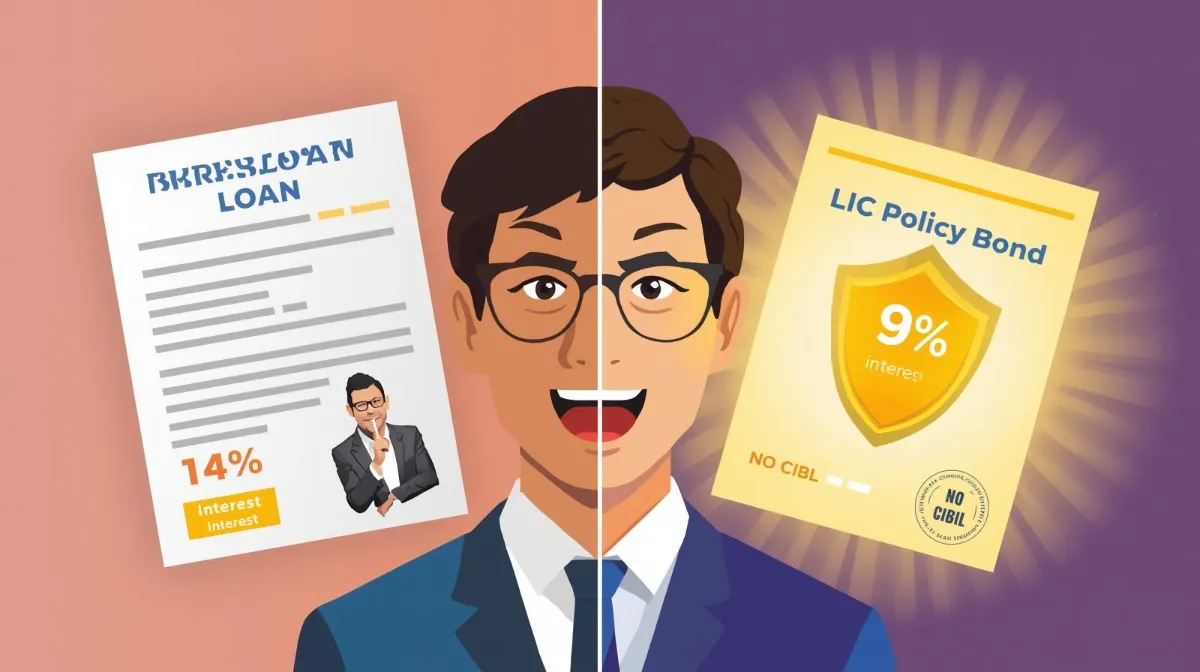
Introduction: Why Pay 14% When You Can Pay 9%?
If you check your SMS inbox right now, you probably have a message saying: “Congratulations! You are eligible for a Pre-Approved Personal Loan of ₹5 Lakhs!”
It’s tempting. Personal loans are fast, digital, and require zero collateral. But they are also expensive. The average interest rate for a personal loan in India ranges from 11% to 16% (or even 24% if your CIBIL score is low).
But what if I told you there is a loan product sitting in your drawer right now that could save you thousands of rupees in interest? If you have a traditional LIC policy (Endowment or Money Back), you are sitting on a goldmine.
A Loan Against LIC Policy is one of the cheapest, fastest, and most ignored borrowing options in India.
In this detailed face-off, we will compare the Loan Against LIC Policy vs. the Personal Loan. We’ll break down the interest rate differences, the hidden rules, and why borrowing from your own policy might be the smartest financial move you make this year.
I. What is a Loan Against LIC Policy?
Before we compare, you need to understand how this works. You aren’t borrowing money from LIC; you are borrowing against the value of your own savings.
The “Surrender Value” Concept
You cannot borrow the full Sum Assured (e.g., ₹10 Lakhs). You can only borrow against the Surrender Value—the amount LIC would pay you if you stopped the policy today.
- The Limit: Typically, LIC gives you a loan of up to 90% of the Surrender Value.
- Eligibility: Your policy must be active and at least 3 years old (to have acquired a surrender value).
II. The Great Showdown: LIC Loan vs. Personal Loan
Let’s look at the hard numbers. Why should you choose one over the other?
1. Interest Rate (The Winner: LIC)
- Personal Loan: The rate depends on your CIBIL score and employer profile. It usually starts at 10.5% and goes up to 24%.
- LIC Loan: The rate is fixed by LIC and is usually much lower, currently hovering around 9% to 10% per annum.
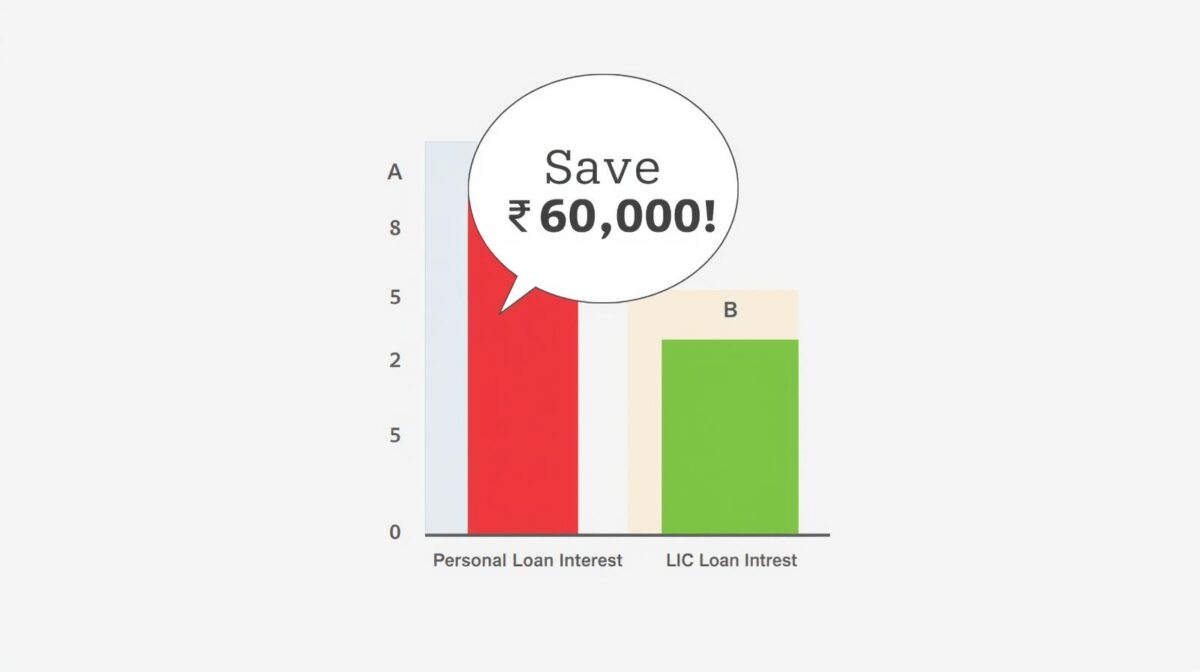
- Impact: On a ₹5 Lakh loan for 5 years, a 4% difference in interest can save you roughly ₹60,000.
2. CIBIL Score Requirement (The Winner: LIC)
- Personal Loan: If your CIBIL score is below 700, your application will likely be rejected or you’ll be charged a “risk premium” (higher rate).
- LIC Loan: Zero CIBIL check. Since you are borrowing against your own money (collateral), LIC doesn’t care if your credit score is 300 or 900. Approval is guaranteed if the policy has value.
3. Repayment Flexibility (The Secret Weapon of LIC)
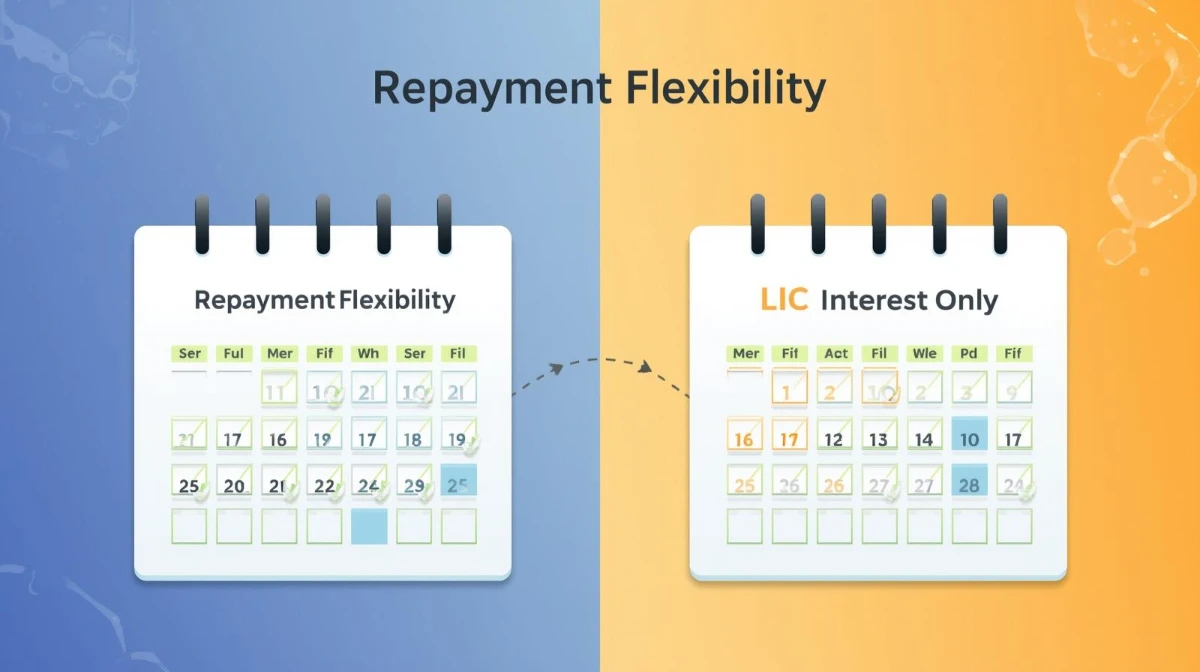
This is the biggest advantage that nobody talks about.
- Personal Loan: You must pay the EMI (Principal + Interest) every month. If you miss one, you get hit with penalties and your CIBIL score crashes.
- LIC Loan: You have amazing flexibility.
- Option A: Pay Interest + Principal (like a normal EMI).
- Option B: Pay ONLY Interest every 6 months. You can pay back the Principal amount whenever you have the cash (bullet payment) or even let it be deducted from the final claim settlement!
- Best for: Freelancers or businessmen with irregular cash flow.
4. Processing Fees & Foreclosure Charges
- Personal Loan: Banks charge 1% to 2% processing fees + GST. If you want to close the loan early, they charge a Foreclosure Fee (up to 4%).
- LIC Loan: Minimal or zero processing fees. Absolutely zero foreclosure charges. You can pay it off tomorrow without a penalty.
III. The Comparison Table: At a Glance
| Feature | Personal Loan | Loan Against LIC Policy |
| Interest Rate | 11% – 24% (High) | 9% – 10% (Low) |
| CIBIL Check | Mandatory (Strict) | Not Required |
| Loan Amount | Based on Income (High limit) | Limited to 90% of Surrender Value |
| Processing Time | Instant / 24 Hours | 3 to 7 Days (Physical/Online) |
| Repayment | Strict Monthly EMIs | Flexible (Interest Only option) |
| Risk | Default hurts CIBIL score | Default reduces Policy Claim amount |
IV. The Catch: When Should You AVOID an LIC Loan?
It sounds perfect, but there are limitations.
- Low Loan Amount: If you bought your policy only 4 years ago, your Surrender Value is likely very low. Even if your Sum Assured is ₹20 Lakhs, your loan eligibility might only be ₹50,000. Personal loans offer much higher amounts (up to ₹25 Lakhs or more).
- Risk to Family: The purpose of LIC is to protect your family if you die. If you take a loan and pass away before repaying it, LIC will deduct the loan + interest from the Death Claim. Your family will receive significantly less money than you planned for them.
- Term Plans: You cannot take a loan against a Term Insurance Plan. This is only for endowment/money-back policies.
V. How to Apply (Step-by-Step)
In 2024, you don’t necessarily need to visit the branch.
- Online Method:
- Log in to the LIC e-Services portal.
- Check “Loan Status” to see your eligible amount.
- Apply online, link your bank account (NEFT), and the money is credited within 3-5 working days.
- Offline Method:
- Visit your servicing branch with the original policy bond.
- Fill out the loan application form (Form 5196).
- Submit a cancelled cheque.
- Important: You must submit the Original Policy Bond to LIC. They keep it as security until the loan is repaid.
Conclusion: The Verdict
If your loan requirement is small (within your policy’s surrender value limit), always choose the Loan Against LIC. It is cheaper, flexible, and CIBIL-free. It is essentially using your own idle money to fund your needs.
However, if you need a large amount (e.g., ₹10 Lakhs) instantly for a medical emergency and your policy is young, a Personal Loan is your only viable option despite the higher cost.
Smart Move: Before you click “Apply” on that expensive bank loan, log in to the LIC portal and check your surrender value. You might just save yourself 5% in interest.
⚠️ Disclaimer
Financial Disclaimer: The interest rates mentioned (9-10% for LIC, 11-24% for Personal Loans) are based on current market trends in India as of 2024 and are subject to change. Loan eligibility is at the sole discretion of LIC of India or the respective banking institution. Please consult a financial advisor before pledging your insurance policy, as it impacts the death benefit protection for your nominees.
❓ Frequently Asked Questions (FAQ)
Q1. Can I take a loan against a Term Insurance policy?
A. No. Term insurance has no “savings” component and no Surrender Value. Therefore, LIC cannot give a loan against it. This facility is only for Endowment, Money Back, and Whole Life plans.
Q2. What happens if I don’t repay the LIC loan principal?
A. Unlike a bank, LIC won’t send recovery agents to your house. If you keep paying the interest, the loan can continue indefinitely. If the policy matures (or if death occurs) and the principal is still unpaid, LIC will simply deduct the loan amount from the final settlement pay-out.
Q3. Does taking an LIC loan affect my CIBIL score?
A. It depends on the usage. If you use the loan money for purchasing, constructing, or repairing a house, you may claim a tax deduction under Section 24(b). If used for business, it might be a business expense. If used for personal needs (wedding/vacation), there is no tax benefit.