

For the salaried employee, budgeting is a relatively straightforward equation: take your fixed monthly income, subtract your fixed expenses, and the remainder dictates your savings and discretionary spending. But what if your income is a volatile landscape, changing drastically from one month to the next?
Welcome to the world of freelancers, gig workers, small business owners, and commission-based professionals—the “unpredictable income” generation. Traditional budgeting methods feel like trying to catch mist in a net; they simply don’t apply.
The good news is that managing variable income is not only possible but, with the right strategies, can lead to incredible financial resilience. It demands a shift in mindset from monthly stability to long-term average and buffer building. This comprehensive guide will provide a robust framework to conquer income variability and establish lasting financial peace.
Why Traditional Budgeting Fails the Unpredictable Earner
The standard 30-day budget works on the assumption of consistency. When you don’t know if your next paycheck will be ₹50,000 or ₹2,50,000, setting fixed categories becomes an exercise in frustration.
- Fixed Expense Overload: A low-income month can quickly make fixed expenses (rent, loan payments) feel overwhelming, leading to anxiety and reliance on credit.
- The Feast or Famine Cycle: High-income months often lead to overspending (the “feast”) because the earner feels financially safe, only to panic during a subsequent “famine” month. This cycle prevents consistent wealth building.
- Difficulty in Goal Setting: Saving for major goals like retirement or a down payment seems impossible when the base income is unstable.
The solution is to adopt a budgeting system that flexes with your income, treating your cash flow like a reservoir—saving when it’s high and drawing when it’s low.
Phase 1: Establish Your Financial Foundation

Before implementing any fancy budgeting technique, you must solidify your baseline financial knowledge.
1. Calculate Your True Minimum Monthly Expense (T.M.M.E.)
Your T.M.M.E. is the absolute bare minimum you need to survive, not thrive. This calculation is crucial because it sets the bar for your financial survival during the leanest months.
- Needs Only: Include non-negotiable costs: housing (rent/mortgage), utilities, essential groceries, minimum debt payments, and basic transportation.
- Exclude Wants: Temporarily remove dining out, entertainment, subscriptions, and non-essential shopping.
- The T.M.M.E. Example: If your minimum essential costs total ₹65,000, this is the figure you must protect above all else.
2. Build the Income Buffer (The “Anti-Emergency Fund”)
The traditional emergency fund is for unforeseen events (like a major car repair or medical bill). The Income Buffer is specifically for the unforeseen lack of work or late client payments.
- Goal: Aim to save enough cash to cover your T.M.M.E. for three to six months.
- Purpose: Once fully funded, this buffer allows you to survive a few slow months without touching investments or going into debt. It is the single most effective tool for emotional and financial stability for unpredictable earners.
- Where to Keep It: A high-yield savings account that is easily accessible but separate from your daily checking account.
3. Separate Business and Personal Finances
This step is non-negotiable, especially for freelancers. Mixing funds makes expense tracking, tax calculation, and personal budgeting nearly impossible.
- Dedicated Bank Accounts: Use a separate checking account and credit card for all business income and expenses.
- Pay Yourself a Salary: Do not spend directly from your business account. Decide on a realistic monthly “salary” to pay yourself from the business account into your personal account. This regular transfer immediately creates a predictable income stream for your personal budget.
Phase 2: Implementing Flexible Budgeting Strategies
Once your financial foundation (T.M.M.E. and Income Buffer) is stable, you can adopt flexible budgeting methods that specifically address variable cash flow.
4. The Monthly Huddle System (The “Zero-Based” Approach)
The Zero-Based Budgeting (ZBB) philosophy ensures every rupee earned has a job, which is particularly vital for unpredictable income. However, instead of using ZBB before the month starts (which is impossible), you use it when the money arrives.
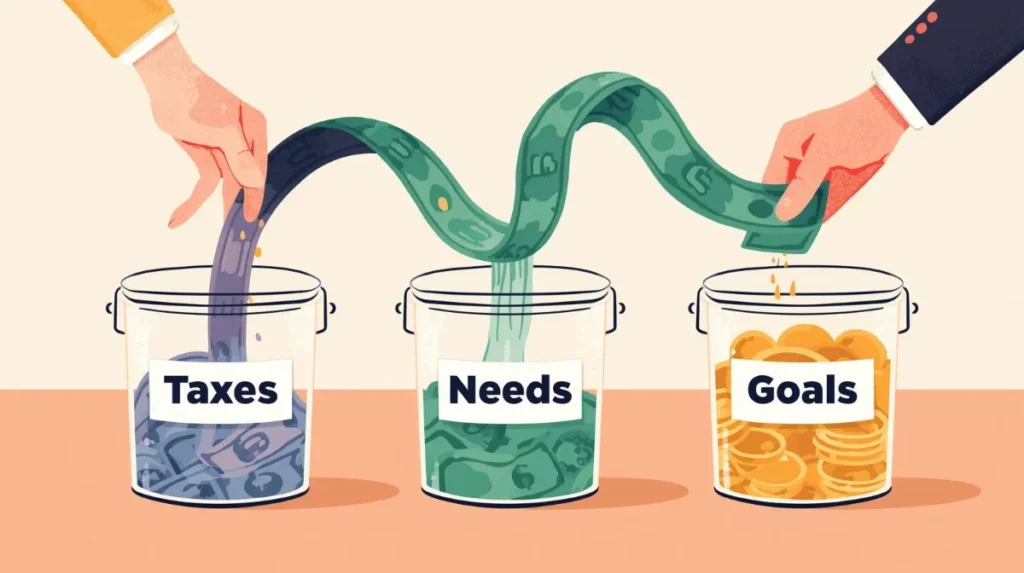
A. Allocate Income by Priority: When a paycheck or client payment hits your business account, immediately transfer the funds into specific categories based on a set percentage, rather than a fixed amount.
| Priority | Allocation Percentage (Suggested) | Description |
| P1 | 20% – 30% | Taxes & Emergency (Set aside estimated tax, plus buffer contribution). |
| P2 | 50% – 60% | Operating Expenses (Funds needed to pay your monthly personal ‘salary’ and minimum debt). |
| P3 | 10% – 20% | Future Goals & Investing (Retirement, large savings goals, or passive investing). |
B. The “Last Month’s Income” Method: This is the gold standard for creating personal stability. The goal is to live this month on the income you earned last month.
- When you earn money in January, you do not touch it until February 1st.
- By February 1st, you have a solid, known amount of income to budget for the entire month.
- This method effectively divorces your spending habits from the roller-coaster of your cash flow, mimicking the stability of a salaried job.
5. Budgeting by Paycheck: The Bucket System
For highly volatile cash flow (where small payments arrive constantly), think in terms of “buckets” or sinking funds, rather than calendar months. Every time a payment comes in, you fund the buckets in order of importance until they are full.
- Bucket 1: Immediate Needs (T.M.M.E.) – Fund this first. This covers rent, minimum debt, and basic utilities.
- Bucket 2: Taxes & Buffer – Fund this second. This is mandatory for legal compliance and stability.
- Bucket 3: Future Needs (Sinking Funds) – Fund this next. Categories include annual insurance premiums, quarterly taxes, and upcoming holidays.
- Bucket 4: Wants & Investing – Fund this last. Discretionary spending, entertainment, and extra investments.
When a large payment arrives, all buckets get filled quickly. When a small payment arrives, it just tops up Bucket 1 and starts on Bucket 2.
Phase 3: Mastering Tax and Sinking Funds
For the unpredictable earner, taxes and irregular annual expenses are the biggest hurdles.
6. Tax Management: The Non-Negotiable Fund
Unlike salaried employees whose taxes are deducted automatically, freelancers must manage quarterly or yearly tax obligations. Failure to do so can derail your entire budget.
- Set Aside Immediately: As soon as you receive a payment, immediately move the estimated tax amount (consult with your accountant for the accurate rate in your region) into a separate, dedicated savings account.
- Do Not Mix Funds: This tax money is not yours. It is the government’s money, held by you temporarily. Do not use it to cover a shortfall in your personal expenses.
- Quarterly Check-ins: Meet with your financial advisor or accountant quarterly to review your income and make estimated tax payments on time, avoiding last-minute stress and potential penalties.
7. Utilising Sinking Funds for Irregular Costs
Sinking funds are mini-savings goals for expected, yet infrequent, expenses. They are critical for smoothing out your annual budget.
- Identify Irregular Expenses: List everything you pay annually or semi-annually (e.g., life insurance premium, annual software subscriptions, car maintenance, holiday gifts).
- Calculate the Monthly Cost: Take the total cost of each item and divide it by the number of months until the due date.
- Example: If your annual car insurance premium is ₹24,000, you must put ₹2,000 into the “Car Insurance Fund” every month.
- Integration: Add the total of all sinking fund contributions to your monthly essential expenses. By automating this, you eliminate those stressful “surprise” large bills.
Phase 4: Debt Management and Long-Term Growth
Managing debt and planning for the future requires a specific focus when income is irregular.
8. Strategic Debt Repayment
When faced with volatile income, aggressively tackling high-interest debt (like credit card debt or personal loans) is paramount because high interest payments become even more burdensome during low-income months.
- The Debt Snowball/Avalanche Modification: When a large payment or a “high-income month” occurs, dedicate a significant lump sum (e.g., 50% of the surplus income after taxes and buffer contributions) toward debt principal reduction. In lean months, you only make the minimum payments. This stops the interest clock faster than consistent, small payments alone.
- Focus on the Rate: Prioritize debts with the highest interest rate (the Avalanche Method) to minimize the total amount of interest paid over time, especially since the repayment timeline is often extended due to income variability.
9. Automate Your Investing for Future-Proofing
It’s common for unpredictable earners to delay retirement or long-term investing, prioritizing immediate stability. However, the power of compound interest demands consistency.
- Treat Investing as a Fixed Expense: Once your Income Buffer is established, treat your monthly investing goal (e.g., 10% or 15% of your average income) like rent—it must be paid.
- Automate on a Set Date: Set up an automatic transfer for a minimal, achievable amount to your retirement account (like a mutual fund or index fund) for the same date every month. This ensures you contribute even in slow months.
- Boost with Bonuses: When a large project bonus or “fat” month occurs, immediately transfer a lump sum top-up into your investment accounts. This maximizes the surplus while maintaining a predictable base investment.
Phase 5: The Psychological Framework
Budgeting for unpredictable income is often more about psychology than mathematics. Overcoming the “feast or famine” mindset is crucial for success.
10. Normalizing the “Average” Income
Stop comparing your current month’s income to the previous month’s. Instead, look at your six-month or twelve-month rolling average income.
- The Calculation: Sum up your net income for the last 12 months and divide by 12.
- $Average\ Monthly\ Income = \frac{\sum_{i=1}^{12} Net\ Income_i}{12}$
- The Benefit: This average is the number you should mentally use for long-term planning, setting realistic savings goals, and determining how much “salary” you should pay yourself monthly from your business account. When a month is low, you know you are just slightly below the average; when it’s high, you recognize it’s a contribution to the average.
11. Creating the Spending Policy
One of the biggest pitfalls is overspending during a peak month. Implement a clear rule: Surplus is for Savings/Debt/Investing first, and Splurging second.
- The Rule of Halves: If you have ₹1,00,000 extra this month after covering your T.M.M.E., the rule might be: 50% (₹50,000) goes directly into long-term wealth (debt, investment, buffer), and only the remaining 50% is available for discretionary spending or rewards. This prevents the “feast” from entirely cannibalizing your future stability.
Conclusion
Budgeting with unpredictable income requires discipline, a multi-month perspective, and the commitment to create your own stability where the market offers none. By rigorously establishing an Income Buffer, meticulously managing Taxes, and adopting flexible frameworks like the Monthly Huddle System and Sinking Funds, you transform financial anxiety into financial empowerment.
Your income may fluctuate, but your financial plan should not. Embrace the strategies outlined here, and you will find that a variable income can actually become a powerful tool for rapid wealth acceleration, provided you manage the surpluses wisely.
Read More – How to Apply for an Education Loan Online — Step by Step Guide







2 thoughts on “The Ultimate Guide to Budgeting When Your Income is Unpredictable (For Freelancers & Gig Workers)”