

Laxmi Aayi Hai
The moment a baby girl is born in an Indian family, amidst the celebration and sweets, a thought silently plants itself in the father’s mind: “I need to save for her wedding and education.”
It’s an emotional instinct. You want to give her the best future possible.
You go to the bank, and the manager gives you two options:
- Public Provident Fund (PPF): The classic, trusted option.
- Sukanya Samriddhi Yojana (SSY): The special government scheme for girls.
On paper, SSY looks like the clear winner because it offers a higher interest rate. But is interest rate the only thing that matters? No.
What if your daughter decides to study abroad and becomes an NRI? What if you face a financial crisis after 10 years? This is where the “fine print” matters.
In this comprehensive guide, we won’t just compare percentages. We will pit SSY vs. PPF in a battle of flexibility, rules, and returns to help you decide exactly where to park your hard-earned money for your daughter.
I. The Contenders: A Quick Look
Before we fight, let’s meet the players.
1. Sukanya Samriddhi Yojana (SSY)

Launched under the “Beti Bachao, Beti Padhao” campaign, this is strictly for the girl child.
- Who can open: Parents of a girl child (below 10 years age).
- Current Interest: 8.2% (Govt keeps changing this quarterly, but it is usually the highest).
- The Vibe: High returns, strict lock-in.
2. Public Provident Fund (PPF)
The old reliable friend of every Indian investor.
- Who can open: Anyone (You can open it in your daughter’s name).
- Current Interest: 7.1%.
- The Vibe: Decent returns, moderate flexibility.
II. Round 1: The Returns (The Power of Compounding)
Let’s talk money. Because that’s why we are investing, right?
Scenario: You invest ₹1.5 Lakhs per year (the maximum limit) for 15 years in both schemes.
| Feature | PPF (7.1%) | SSY (8.2%) |
| Annual Investment | ₹1,50,000 | ₹1,50,000 |
| Duration of Payment | 15 Years | 15 Years |
| Total Money Invested | ₹22.5 Lakhs | ₹22.5 Lakhs |
| Maturity Amount (Approx) | ₹40.6 Lakhs | ₹69.8 Lakhs |
| THE DIFFERENCE | – | + ₹29 Lakhs (Winner) |
The Verdict: Purely on numbers, SSY destroys PPF. The difference of nearly ₹29 Lakhs is massive. It can fund an entire MBA degree or a grand wedding. If your only goal is maximizing the corpus, SSY wins hands down.
III. Round 2: The “Lock-in” Nightmare (Where PPF Fights Back)
Here is where the story changes. High returns come with handcuffs.
The SSY Lock-in (Very Strict)
- Maturity: 21 years from the date of opening.
- Education Withdrawal: You can withdraw 50% of the balance only when the girl turns 18 years old (or passes 10th standard).
- Marriage Withdrawal: Full closure is allowed only for her marriage after age 18.
- Problem: If you need money when she is 15 (say, for school coaching or a medical emergency), SSY will not give you a single rupee. Your money is trapped.
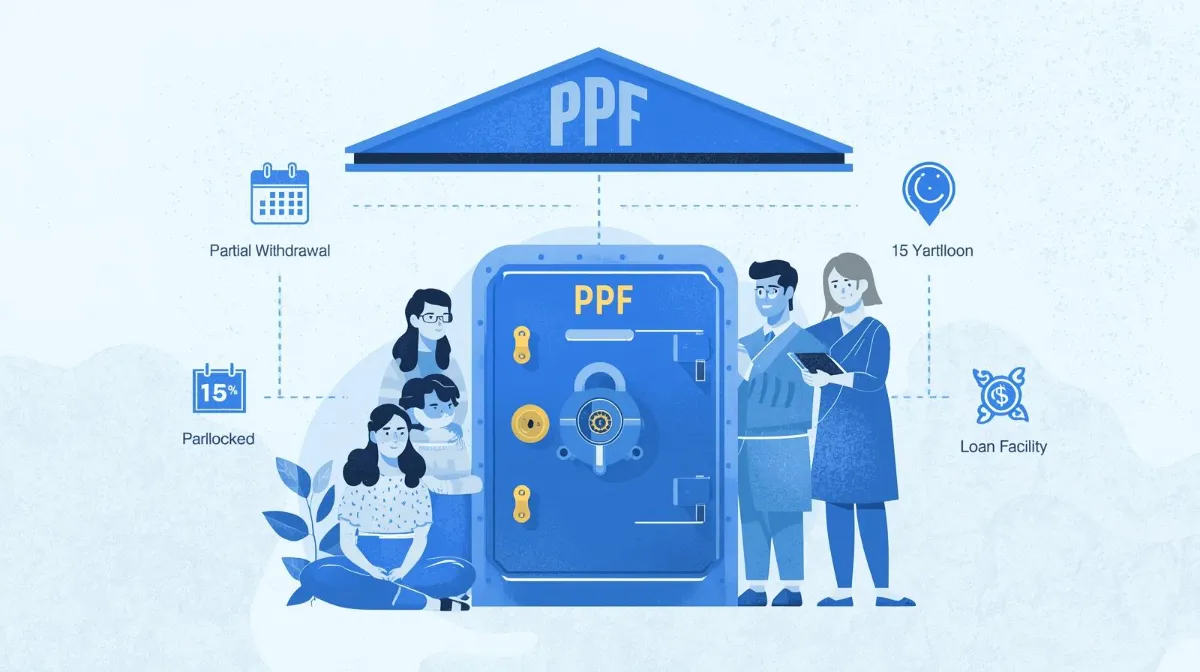
The PPF Lock-in (Flexible)
- Maturity: 15 years.
- Partial Withdrawal: Allowed from the 7th year onwards.
- Loan Facility: You can take a cheap loan against your PPF balance from the 3rd year.
- Extension: You can extend it in blocks of 5 years indefinitely.
The Verdict: If you fear you might need liquidity (cash) before 21 years, PPF is safer.
IV. Round 3: The “NRI” Clause (The Hidden Rule)
This is the point most bank agents hide.
The Scenario: Your daughter is brilliant. At age 18, she goes to the USA or Canada for studies and becomes an NRI (Non-Resident Indian).
- PPF: An NRI cannot open a new PPF, but if it was already opened before she became an NRI, it can continue until maturity. It is safe.
- SSY: According to the rules, if the girl child becomes an NRI or loses Indian citizenship, the SSY account might have to be closed immediately or it stops earning interest (rules on this are strict and subject to change).
The Verdict: If you have concrete plans for your family to settle abroad, SSY might be a bureaucratic headache.
V. Comparison Table: The Final Face-Off
| Feature | Sukanya Samriddhi Yojana (SSY) | Public Provident Fund (PPF) |
| Interest Rate | 8.2% (High) | 7.1% (Moderate) |
| Tax Benefit | EEE (Invest, Interest, Maturity all Tax-Free) | EEE (All Tax-Free) |
| Lock-in Period | 21 Years (or Marriage at 18+) | 15 Years |
| Liquidity | Very Low (Partial at 18) | Moderate (Partial from 7th year) |
| Who can open? | Only Girl Child (<10 years) | Anyone |
| Online Access | Available (Bank/Post Office) | Available |
VI. Action Plan: What Should an Indian Parent Do?
Don’t choose one. Be smart and use a Hybrid Strategy.
1. The “Primary” Goal (SSY)
Open an SSY account immediately. Maximize your investment here (e.g., ₹1 Lakh per year). This is strictly for her Marriage or Higher Education at age 21. Forget this money exists. The 8.2% tax-free return is unbeatable by any other debt product in India.
2. The “Backup” Goal (PPF)
Open a PPF account in your name (or the girl’s name with a smaller amount, e.g., ₹50,000).
- Why? This acts as your safety net. If you need money for her school admission at age 12 or coaching classes at age 15, use the PPF partial withdrawal.
READ MORE – Personal Loan Balance Transfer: How to Reduce Interest Rate from 16% to 11%
Conclusion: Love Meets Logic
Your daughter is precious, and so is your hard-earned money.
- Choose SSY if you are disciplined and want the absolute highest payout for her wedding/degree at age 21.
- Choose PPF if you want decent returns but need access to money for emergencies in between.
The best day to plant a tree was 20 years ago. The second best day is today. Go to your bank app or nearest Post Office and open that account. Your daughter will thank you 21 years from now.
⚠️ Disclaimer
Financial Disclaimer: Interest rates mentioned (8.2% for SSY, 7.1% for PPF) are as per Q4 FY 2024-25 and are revised by the Government of India every quarter. Tax rules (EEE status) are subject to change in future budgets. Please consult a financial advisor before making large investments.
❓ Frequently Asked Questions (FAQ)
Q1. Can I open both SSY and PPF for my daughter?
A. Yes! This is a great strategy. You can have an SSY account in her name and also open a PPF account in her name (as a guardian). However, remember that the total tax deduction under Section 80C is limited to ₹1.5 Lakhs combined for all your investments.
Q2. What happens if I miss the yearly deposit in SSY?
A. The account becomes “Default.” To reactivate it, you have to pay a small penalty of ₹50 for each year of default along with the minimum deposit amount (₹250 per year). It is very easy to revive.
Q3. Can I transfer my SSY account from Post Office to a Bank?
A. Yes. If you started an account in a Post Office but now find it hard to visit physically, you can transfer it to a bank (like SBI, HDFC, ICICI) that offers online deposit facilities. You need to submit a transfer request at the Post Office.
Q4. Is the maturity amount of SSY taxable?
A. No. SSY falls under the EEE (Exempt-Exempt-Exempt) category.
Money invested is tax-free (Sec 80C).
Interest earned every year is tax-free.
Final maturity amount is 100% Tax-Free.







1 thought on “Sukanya Samriddhi Yojana (SSY) vs. PPF: Which is Best for Your Daughter’s Future? (The Real Truth)”